The “machinery question” is often treated as a problem specific to the nineteenth century, resolved by the eventual triumph of industrial progress. Contemporary disputes over artificial intelligence suggest that its underlying issues remain unresolved. In both early industrial Britain and the present debate over AI, anxiety has intensified when new technologies appear to threaten livelihoods, undermine skill, and redistribute economic power. The historical contexts, forms of labour, and technologies involved differ substantially, but the comparison is useful because it highlights a recurring pattern: technological progress does not automatically produce shared prosperity.
This essay argues that the Luddite disturbances and the wider labour crises of early industrial Britain are best understood not as irrational reactions against innovation, but as responses to labour-replacing technologies introduced in ways that weakened workers’ bargaining power, de-skilled production, and concentrated the gains of productivity in the hands of capital. This historical pattern helps illuminate contemporary concerns over AI, although the analogy must be qualified. Whereas industrial mechanization displaced artisanal manual labour in textiles, AI threatens a different range of cognitive and professional tasks, often through partial automation rather than outright replacement. The broader lesson remains: the social consequences of technological change depend on the political and institutional arrangements through which it is introduced.
Luddism and the Rational Politics of Machine Resistance
Hobsbawm’s classic description of machine breaking as “collective bargaining by riot” remains powerful because it restores intentionality to the movement. The Luddites were not attacking machinery in the abstract. They targeted particular employers, frames, and practices that violated customary standards of price, quality, and remuneration. In this sense, the movement was less a rejection of invention than a protest against the use of machinery to undercut labour.
The clearest evidence lies in the 1812 Framework Knitters’ Declaration from Nottinghamshire. Far from denouncing all innovation, the declaration threatened to destroy only those frames that produced “fraudulent and deceitful” goods, failed to pay “the regular prices heretofore agreed”, or compensated workers in anything other than “the current coin of the realm”. The language is revealing. The document framed the protest as a defence of trade standards and customary rights rather than as a war on machines as such. What was at stake was not novelty, but the use of machinery to degrade product quality, evade wage expectations, and transfer risk onto workers. The declaration’s legalistic style also shows that the knitters were attempting to legitimise their actions within an older moral economy rather than presenting themselves as enemies of progress.
Other contemporary sources point in the same direction. Writing from Nottingham on 6 February 1812, magistrate Robert Baker reported that before the troubles “a fifth” of frame workers were already out of employment, and that some hosiers had begun giving work “at reduced prices”, thereby allowing themselves to undersell more reputable masters in the London market. A week later, Reverend John Becher traced the grievances more fully: frame rents remained high, output quality deteriorated, prices for labour were cut, and some masters gave out only half the usual quantity of work while still claiming full frame rent. Even a source hostile to popular disorder conceded that the disturbances emerged from wage pressure, underemployment, and the manipulation of labour conditions. This shifts the analytic emphasis from cultural panic to bargaining power.
This is the strongest historical lesson for any applied comparison with AI. If current anxieties are understood as reactions to deskilling, wage compression, and weakened autonomy rather than fear of novelty, they become historically intelligible. The analogy is not exact, but the logic of protest is comparable.
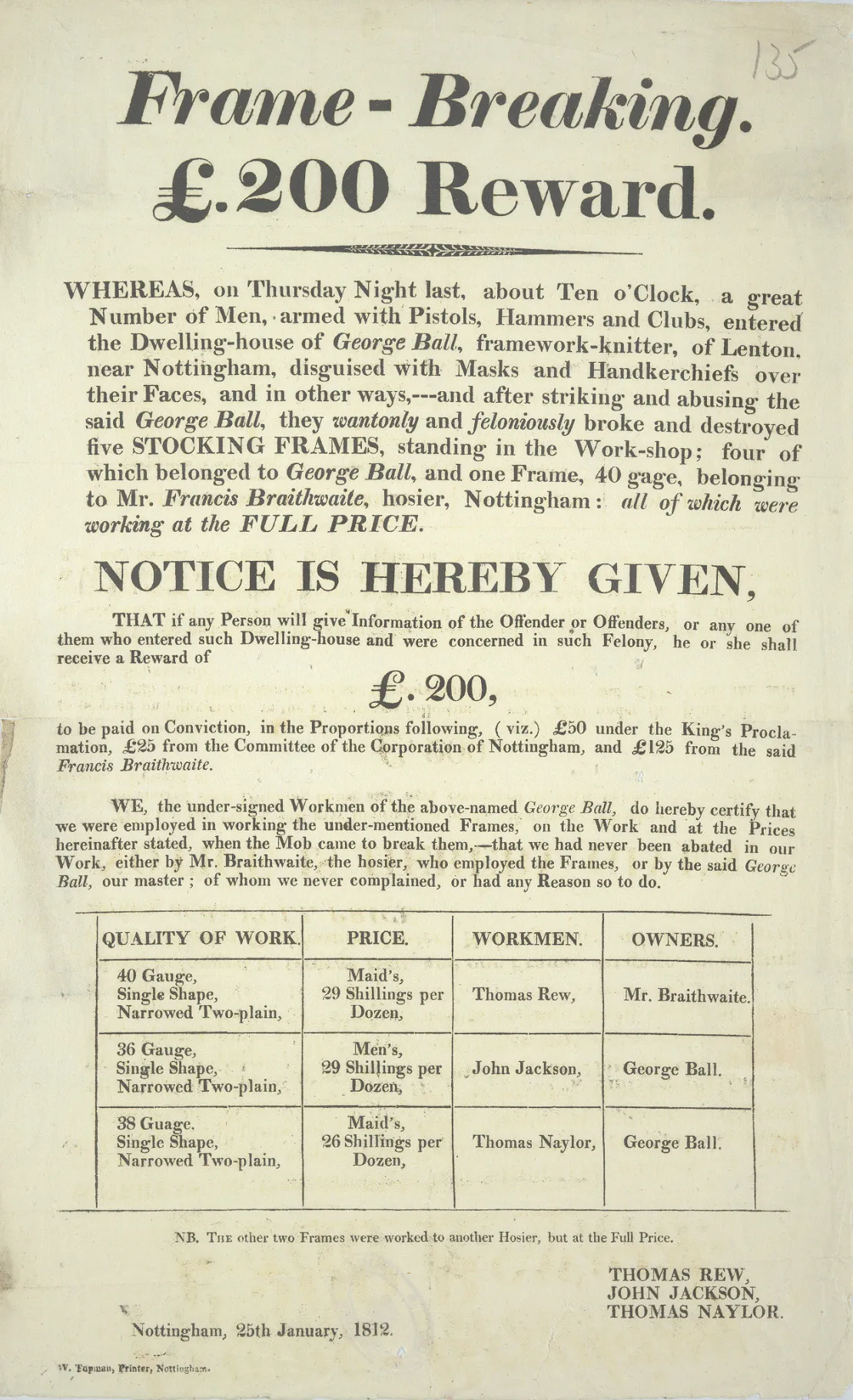
Figure 1. ‘Frame-Breaking. £200 Reward’: notice dated Nottingham, 25 January 1812, detailing the destruction of stocking frames and including workmen’s testimony on quality of work, prices, and frame ownership. The notice claims that the destroyed frames were working at the full price and presents testimony defending the employers. It therefore cannot, on its own, establish that these particular frames undercut wages; rather, it shows how the legitimacy of machine-breaking was contested. Source: HO 42/119, f. 135, The National Archives. Source and transcript (PDF).
Mechanization, De-skilling, and Labour-Replacing Technology
Frey’s distinction between labour-enabling and labour-replacing technologies is useful here. Some technologies extend human capability; others reduce employers’ dependence on scarce skill. The power loom and related textile machinery mattered because they enabled production to be reorganised so that employers could rely less on highly trained workers and more on cheaper, more controllable labour.
That process is visible in the Nottingham evidence. Becher’s 1812 letter is especially valuable because it shows how de-skilling operated through apparently technical adjustments. He described masters changing the “fashion and figure of the work” and using those changes as a pretext to reduce prices beyond any proportionate adjustment. At the same time, he complained of the spread of inferior “single pressed” lace and the multiplication of “independent” frames that intensified competition within an already glutted market. Machines enabled employers to standardise output, cheapen production, and circumvent older wage norms. Technological change thereby became inseparable from managerial strategy.
Engels later described the factory system as one in which labour was subordinated to machinery and to the rhythm of the mill. His account should not be taken uncritically, but it remains useful in identifying what workers perceived: industrial technology was a means of reorganising authority. The issue was not only unemployment. It was the erosion of control over pace, skill, and bargaining position.
The comparison with AI must be handled carefully. Large language models are not the cognitive equivalent of the power loom: in many settings they assist, accelerate, or partially automate tasks while still depending on human supervision. Yet the analogy becomes suggestive when AI is introduced in ways that standardise tasks previously associated with training or professional discretion. The historical lesson is not that every new tool destroys skill, but that employers often have incentives to deploy technology in ways that reduce dependence on expensive labour.
Engels’ Pause and the Failure of Shared Prosperity
Even when mechanization raised output, the gains were not immediately or evenly shared. This is the significance of what economic historians call “Engels’ Pause”: the period during which productivity and output expanded more quickly than real wages for large parts of the working population. Allen’s influential formulation presents the early nineteenth century as a moment when capital accumulation and technical change generated rising inequality before wage growth eventually caught up.
That concept remains useful, but it should not be repeated as a slogan. More recent work by Nicholas Crafts complicates the strongest version of the thesis, arguing that the period should not be treated as straightforward evidence of sharply falling labour share caused by rapid labour-saving innovation alone. Slow wage growth also reflected modest productivity growth in some sectors and demographic pressure. Yet this does not overturn the broader point: even revisionist accounts show that aggregate economic advance did not translate automatically into prompt or proportionate gains for workers.
For an applied history of AI, this is crucial. Public debate often assumes that if a technology increases overall efficiency, the long-run social outcome will be benign. The history of industrialisation warns against that assumption. The historical problem is not whether innovation eventually benefits society in the abstract, but how benefits are distributed in the medium term, and through what institutions.
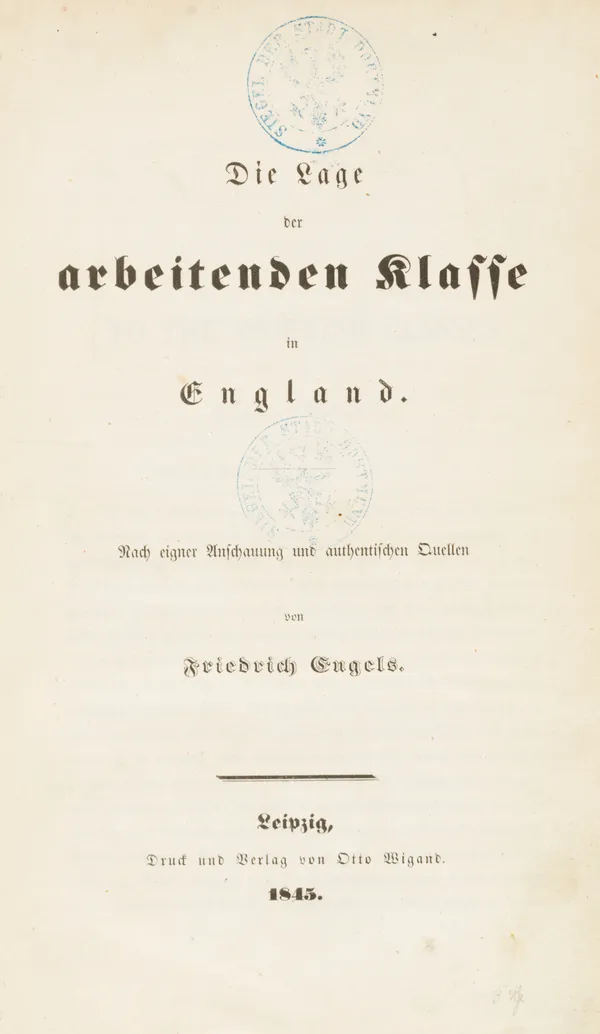
Figure 2. Title page of Friedrich Engels, Die Lage der arbeitenden Klasse in England (Leipzig, 1845). Engels’ account of industrial working-class conditions gave lasting expression to the argument that mechanisation subordinated labour to machinery, and that the gains of rising productivity were not shared with workers during the early decades of industrialisation. Source: Wikimedia Commons, public domain.
State Power, Institutional Choice, and the Governance of Technological Change
Technological outcomes were not dictated by engineering alone. They were shaped by law, coercion, and political priorities. Here the combination of Hobsbawm, Frey, and Acemoglu and Johnson is especially productive. Hobsbawm helps explain why workers turned to machine breaking when excluded from formal channels of power. Frey emphasises that states often backed mechanization because international competition made technological restraint appear strategically dangerous. Acemoglu and Johnson extend the argument by insisting that the direction and distribution of innovation are politically shaped rather than technologically predetermined.
The British response to Luddism illustrates this clearly. Parliament did not treat frame breaking as a narrow industrial dispute; it turned machine breaking into a capital offence in 1812 and deployed troops on a remarkable scale. This was not neutrality. It was a decision to protect property, order, and a particular model of industrial transformation. Even Becher, who blamed both masters and workers for the crisis, proposed regulating frame rents and limiting what owners could charge when they did not provide full weekly work. His proposal shows that contemporaries understood the disturbances not as an unavoidable consequence of progress, but as the result of institutional arrangements that could be changed.
This is where applied history becomes most useful. The point of comparing Luddism with AI is not to claim that data centres are simply the new mills. It is to recover a historical truth often concealed by celebratory narratives of innovation: technological change is governed. Whether new systems complement labour or displace it, whether productivity gains are shared or hoarded, and whether workers retain bargaining power are all questions mediated by policy, law, and organisation.
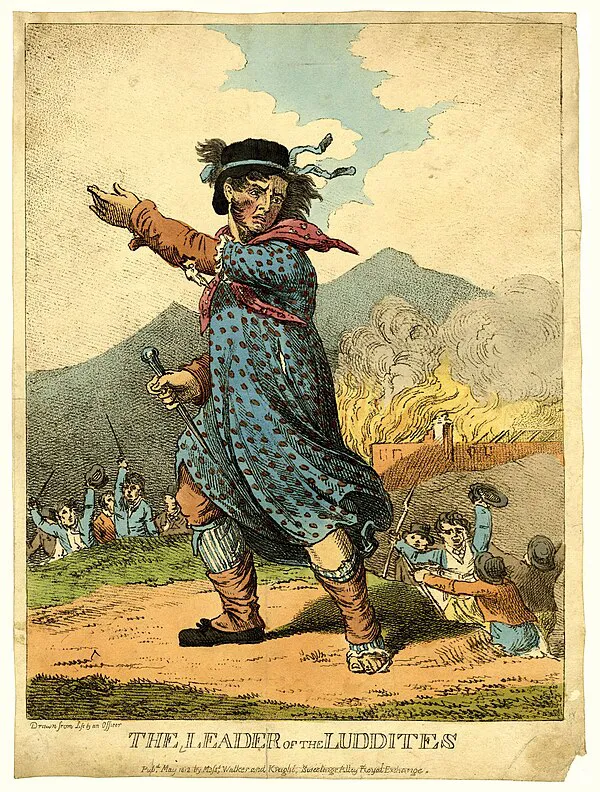
Figure 3. ‘The Leader of the Luddites’, hand-coloured etching, published May 1812 by Walker and Knight, London. The depiction of the Luddite leader as a cross-dressing agitator before a burning building reflects the contemporary propaganda that framed machine-breaking as criminal disorder rather than industrial grievance, helping to justify the Frame Breaking Act (1812) and the large-scale military deployment discussed in this section. Source: Wikimedia Commons, public domain.
Conclusion
The history of labour disruption suggests that conflict around new technology is rarely a simple fear of invention. In early industrial Britain, the sharpest resistance emerged when machinery was introduced in ways that degraded skill, weakened customary protections, and allowed employers to capture the gains of greater productivity while workers bore the losses. Luddism, read through the Framework Knitters’ Declaration and the Nottingham correspondence of 1812, appears less as blind technophobia than as a struggle over wages, standards, and power.
That history does not provide a ready-made script for the age of AI. Mechanized textile production and machine learning systems operate in very different labour markets and social contexts. Yet the comparison remains valuable because it reframes the present debate. The central question is not whether innovation should proceed, but under what terms, for whose benefit, and with what protections against the concentration of gain and the erosion of worker autonomy. Shared prosperity is not the automatic by-product of technical progress. It is a political achievement.
References
Acemoglu, D. and Johnson, S. (2023) Power and Progress: Our 1000-Year Struggle Over Technology and Prosperity. New York: Basic Books.
Allen, R.C. (2009) ‘Engels’ pause: technical change, capital accumulation, and inequality in the British industrial revolution’, Explorations in Economic History, 46(4), pp. 418–435.
Autor, D.H. (2015) ‘Why are there still so many jobs? The history and future of workplace automation’, Journal of Economic Perspectives, 29(3), pp. 3–30.
Baker, R. (1812) Letter to the Home Office describing the situation in Nottingham, 6 February. HO 42/120, ff. 3–4. The National Archives.
Becher, J.T. (1812) Letter to Richard Ryder, Home Secretary, 12 February. Ne C 4919/2. Manuscripts and Special Collections, University of Nottingham.
Crafts, N. (2022) ‘Slow real wage growth during the Industrial Revolution: productivity paradox or pro-rich growth?’, Oxford Economic Papers, 74(1), pp. 1–13.
Engels, F. (1845/1987) The Condition of the Working Class in England. Edited by V. Kiernan. Harmondsworth: Penguin.
Framework Knitters (1812) ‘A Declaration’, 1 January. HO 42/119, p. 119. The National Archives.
Frey, C.B. (2019) The Technology Trap: Capital, Labor, and Power in the Age of Automation. Princeton, NJ: Princeton University Press.
Hobsbawm, E.J. (1952) ‘The machine breakers’, Past & Present, 1, pp. 57–70.