On 22 February 1942, in the small Brazilian town of Petrópolis, Stefan Zweig and his wife took an overdose of sleeping pills and died together.
He left a farewell note. One line in it has stayed with me for a long time:
“…since the world of my own language has sunk away from me, and my spiritual homeland, Europe, has destroyed itself…”
Zweig was the most “European” of the European intellectuals of his generation. His friends included Romain Rolland, Sigmund Freud and Arturo Toscanini. He was not merely “Austrian”, nor merely “Jewish”. He was, in the fullest sense, “European”.
Then came the two world wars. The first destroyed the Habsburg monarchy. The second drove him into exile for good: first to Britain, then to the United States, and finally to Brazil. The “European community of civilisation” he had spent his life defending collapsed, step by step, in front of him. In the end, he did not want to live to see the day it failed completely.
Yet when I first read that line, I was surprised to find that I did not feel especially sad.
What I felt was something else:
I have never had a spiritual homeland that could be destroyed.
What he lost was something he had truly possessed.
In 1910, “I am a European” had real substance: a shared literary canon, a shared humanist tradition, the freedom to move across borders, languages and cities, cafés where friends with different mother tongues argued over the same book. That world had its blind spots and its exclusions, of course. But for Zweig, at least, it had once carried a real way of life.
My generation never had one.
After a few years in Britain, the feeling grows sharper. Studying, working, applying for visas, reading immigration policy, calculating what the future might allow: each of these is concrete, and each is a reminder that you can live here, contribute here, pay taxes here and stay for many years, and still not truly belong. Since Brexit, Britain’s answer to the question of who belongs here has grown narrower and narrower. Then there is America today: ICE seizing people in the streets, democratic procedures once thought unshakeable being tested again and again. The place once called the beacon of the free world is now best pictured by the detention centres on its border.
Every welcome that once looked solid is becoming conditional.
As for me, the place I really want to go back to is not “China”. Since the pandemic, politics there has steadily tightened. Speech is not free, and neither is the person. My values, my politics and my intellectual training do not allow me to accept many aspects of that system.
Shanghai, Beijing, London and Boston all matter to me, of course. But my relationship with each of them is functional. Each can be a work base, a business trip, or simply a vacation. Each can hold one part of my life: studying, working, seeing people, sitting in meetings, brief excitement, brief exhaustion. None of them is the original coordinate.
Only Zigong, in Sichuan, was never a destination. It was the default setting, the place I set out from.
But Zigong, too, is becoming blurred.
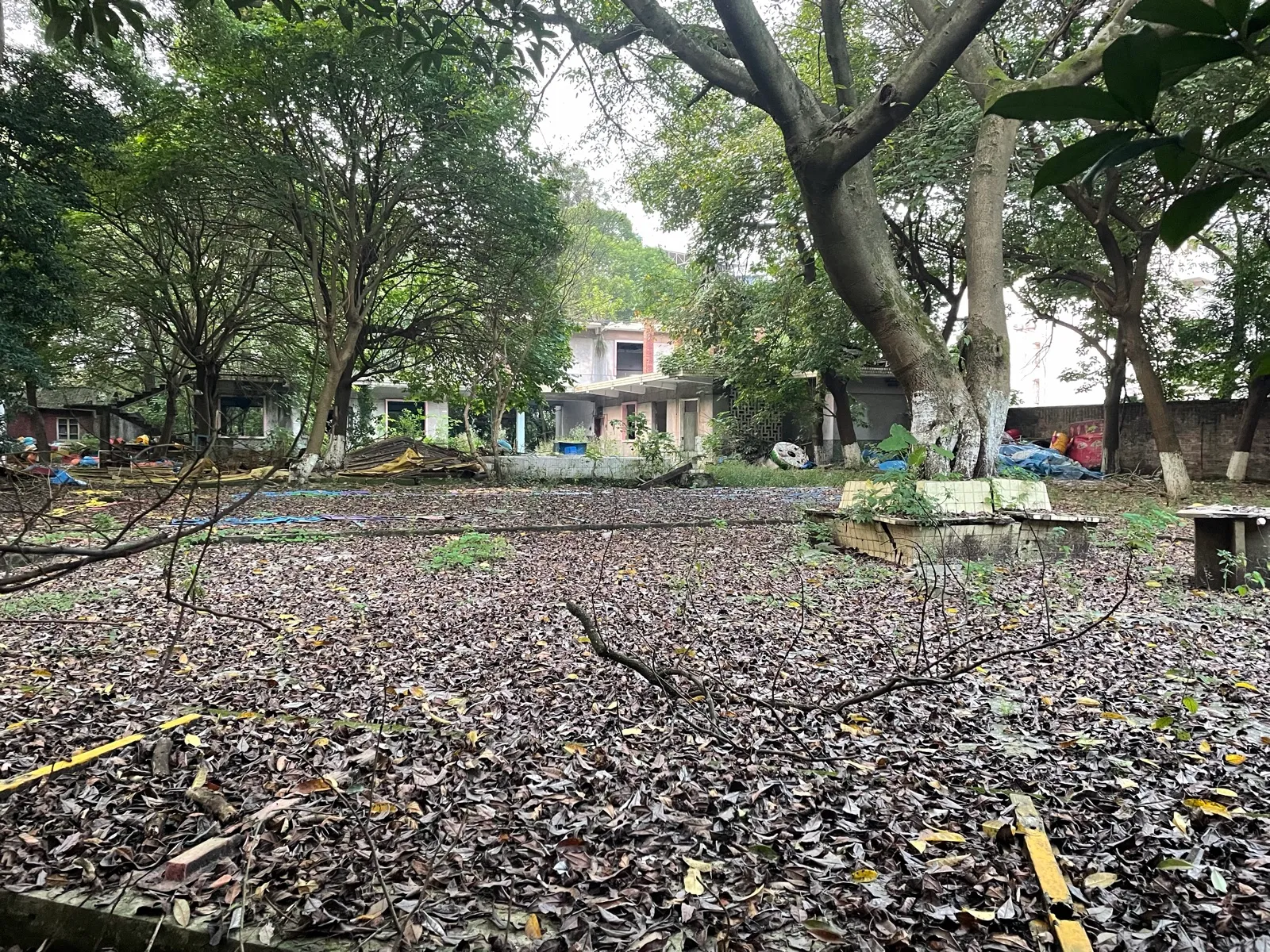
The playground of my childhood has long since changed beyond recognition. In the photograph, you can no longer tell it was ever a playground: only trees, fallen leaves, broken railings and an empty patch of ground that is far too quiet. I can still hear the laughter, but the shapes in my memory no longer match anything in front of me.
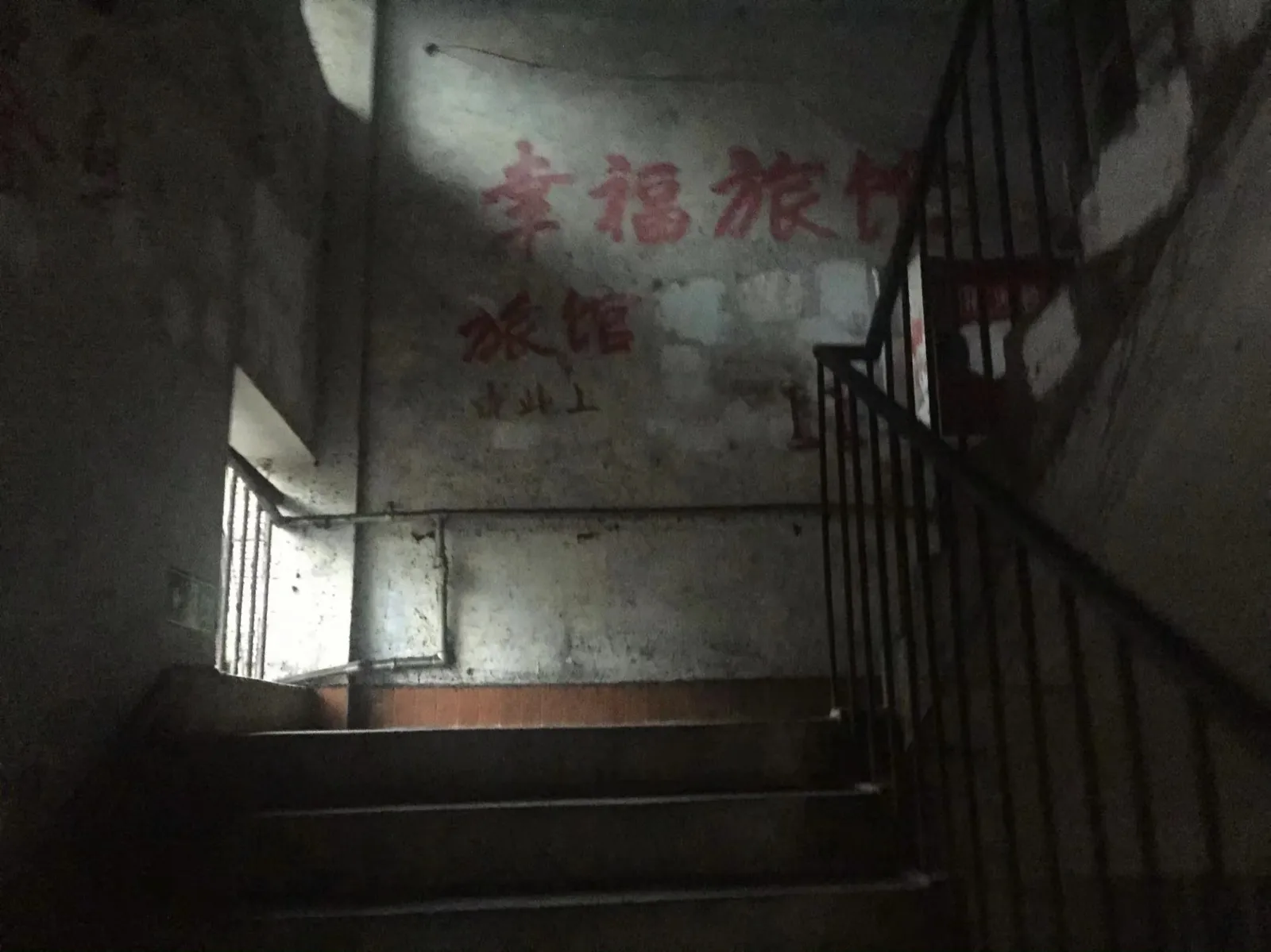
The old building is still standing, too. I moved away almost ten years ago. The words “Happiness Inn” are still on the wall, but the place has long been empty. The happiness remains; the inn is gone. The sign remains; the life is gone. The walls still stand; everyone who lived inside has left.
A place does not say a formal goodbye the way a person does. It simply stops answering you, a little at a time.
On a trip home six years ago, I walked past an old stone wall and saw these words:
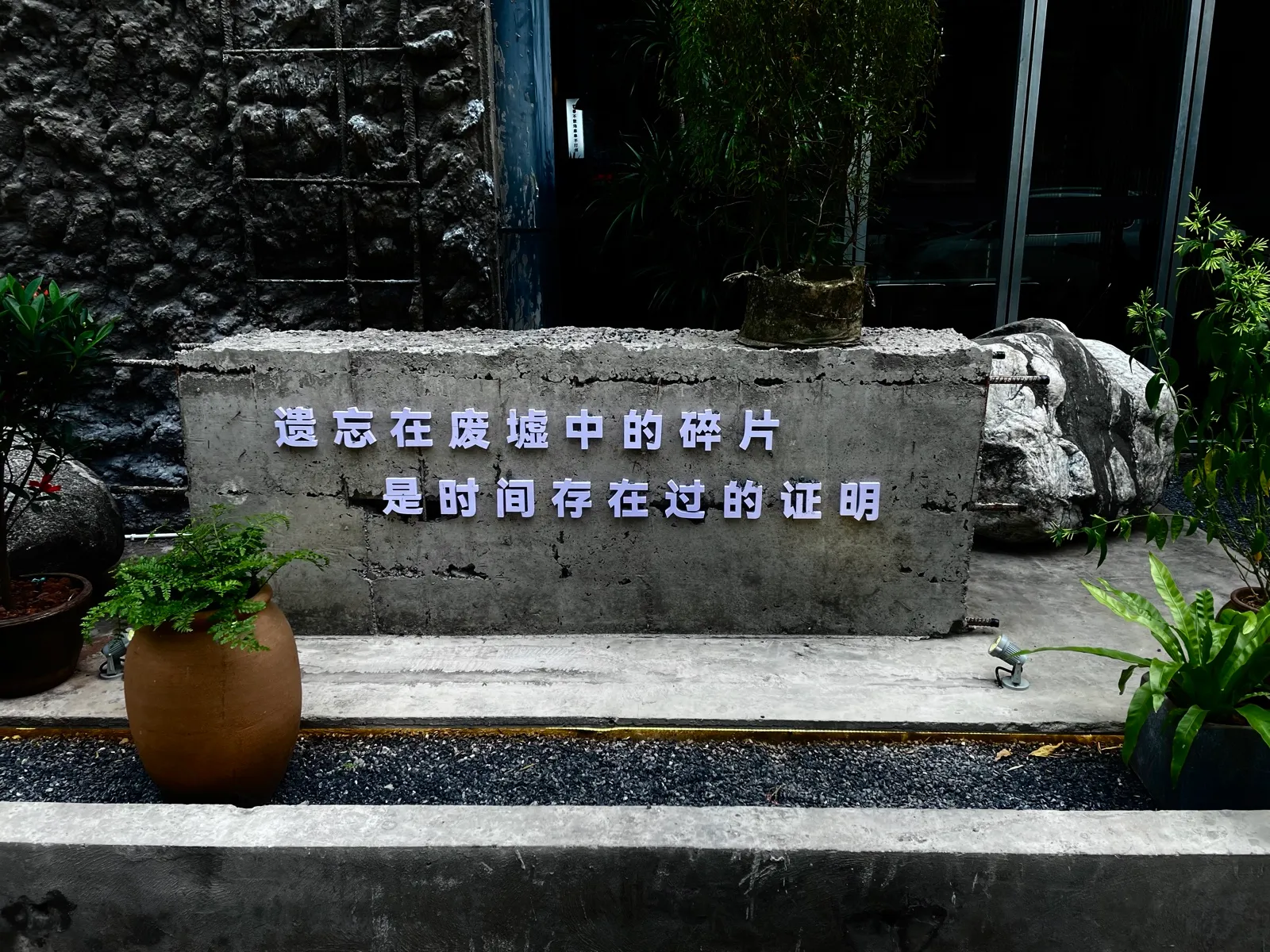
“The fragments forgotten in the ruins are proof that time once existed.”
At the time, the line seemed to be written for that city. It also seemed to be written for me.
Only later did I realise that what I wanted to go back to was Zigong at a particular moment in time.
And that place is gone for good. Bit by bit it shrinks and fades, passing from reality into memory, and from memory into a few photographs, a few old phrases, a few words on a wall.
It still exists, but more and more it feels like evidence: proof that I once lived there, proof that that time really happened, and proof that I can never fully go back.
Zweig could at least mourn the world he lost. For my generation, even the thing we mourn is blurred. The hometown is still there, but it is no longer a homeland. The new places take us in, but they will never quite be home. A loss without clear edges is harder to deal with.
We have spent too much time asking the wrong questions.
“Where am I really from?” “Which culture do I belong to?” These questions assume that a noun is waiting for us at the end: a nation, a cultural identity, a hyphenated label. We think the problem is that we cannot find the noun.
But all along we have been searching an empty slot for a label that does not exist. Zweig’s generation lost a “European” identity that had really existed. My generation is looking for an answer of the form “I am an X” that was never there in the first place.
As the global order fragments, the foundations of every fixed identity are being destroyed. American identity is splitting apart. European identity is splitting apart. The “citizen of the free world” has all but ceased to exist.
In “Reflections on Exile”, Edward Said describes the exile’s vision as contrapuntal: the exile always sees the same thing from two angles and can never fully belong to either group.
This not-belonging brings clarity. Once you see two worlds at the same time, it becomes hard to believe everything either side tells you.
But clarity has a price. It feels closer to a permanent sadness: lasting, low-grade sorrow. Always present, seldom fully part of the scene.
So why keep asking these questions?
There is no need to keep squeezing yourself into a noun, a tag: “new immigrant”, “international student”, “American-born Chinese”. Every noun is inaccurate. Each time you finish explaining, the other person nods, without necessarily having understood.
A more accurate way is to understand identity as a verb.
I am a… becomes I am …ing.
Translating between languages.
Switching between work ethics.
Adjusting to different social rhythms.
Weighing different traditions of value.
Moving, translating and connecting between all of them.
This way of understanding yourself sounds unstable, but it is closer to the truth than any fixed identity, because it no longer depends on the stability of an outside framework. It depends on the continuity of a person’s own experience.
Whatever the time zone, the context or the culture, what keeps happening is the same: moving between A and B, translating, looking for meaning, keeping your own judgement.
This self-understanding has an unexpected benefit, too. You do not have to wait for the times to supply a stable answer before you can go on living. Nor do you have to keep asking when things out there will settle down, because the answer, most likely, is never. The whole era has entered a state of uncertainty. Some people have simply lived inside that uncertainty for many years longer, and learned earlier how to live with it.
As more and more people grow anxious about where they really belong, those who have long lived in the gaps may find a strange calm inside themselves. The question has not been solved. They have learned to carry it while they go on working, loving and choosing.
Identity is no longer a noun. It is a verb.
So there is no need to rush to answer “Where am I from?” or “What am I?”
There is a more honest answer, and a truer one:
To be someone who thinks in the cracks between all of these.
Between Chinese and English, between Zigong and London, between childhood and the present, between wanting to go back and being unable to.
This is not a stable identity.
But at least it is the way I have actually lived.