
The Mbappé story struck me as nothing but absurd.
At the end of October, a clip from an interview began to circulate. The host asked Kylian Mbappé which meme of himself he liked best. He said it was one with his face pasted onto “someone”: “I think he’s a Chinese dictator.” The man in the picture was Mao Zedong. Over the next few days Dongpeng Beverage, Mengniu and Milkground ended their deals with him one after another, China Central Television stopped showing the La Liga matches in question, Mbappé apologised, and Real Madrid apologised too.
As for opinions, there are naturally two sides. On one side are the Chinese Communist Party and its mouthpieces: insulting a former leader is unforgivable, all the more so from a mere footballer, and when the very foundation of the Party is held up for ridicule, a fierce reaction is only to be expected. The other side is the usual refrain: the Chinese Communist Party allows no freedom of speech and tolerates no view but its own; and Xi Jinping, stung, takes it as a jab at himself, since he is the real dictator after all. As Orwell wrote in Nineteen Eighty-Four: Big Brother is watching you.
But I saw a subtler point: politics turned into entertainment.
I. Two Echo Chambers
To talk about politics as entertainment, we have to start with echo chambers. To carry on from Extreme Euphoria: under extreme euphoria, everyone lives inside an echo chamber. Small circles are echo chambers, large circles are echo chambers, and even the Chinese internet and the internet outside China are each one enormous echo chamber. When you are sunk in euphoria, you pay careful attention only to what is inside your chamber; toward everything outside it, you have nothing but mockery, insult and entertainment taken to extremes.
The “dictator” meme of Mbappé was already a widely shared joke, with one version in each chamber. On the Chinese internet, his head was put on a Nazi uniform, and he kicked Ousmane Dembélé and Harry Kane to the floor at the Ballon d’Or ceremony, shouting “It’s mine! It’s mine!” Outside China, where Mao Zedong is generally regarded as a dictator, his face was pasted onto Mao’s.
Mbappé himself lives inside the echo chamber of the internet outside China. To him, a meme that puts his face on a recognised dictator, even an unflattering one, was nothing more than a simple joke, so on the show he made the same joke at his own expense.
But of all things, he said it himself, in his own words, even though he couldn’t name the man in the picture. That naturally gave the mouthpieces their opening. I never thought it would blow up like this. A meme made for fun is only teasing; it has nothing to do with insulting China or insulting the Chinese Communist Party. Yet the reaction was even fiercer than the one Mesut Özil faced back then. I didn’t see it coming, and he probably saw it coming even less. What he couldn’t see was the other echo chamber.
II. A Dead Totem
In that chamber, Mao Zedong is the foundation the Chinese Communist Party stands on. Everyone would like to criticise him into the ground, but nobody dares to make him look ridiculous, because he is the Party itself. This creates an absurd situation: everyone, and by that I mean everyone who thinks, has some basic view of Mao Zedong, but no one, at any time, can express it, whether as love, praise, criticism or insult. He is a totem, a dead totem: he exists, but he cannot be judged. Under Xi Jinping this is truer than ever. The struggle with Bo Xilai made it impossible for officialdom to openly embrace and praise Mao; but because it is still the Communist Party, it has to defend him and protect him.
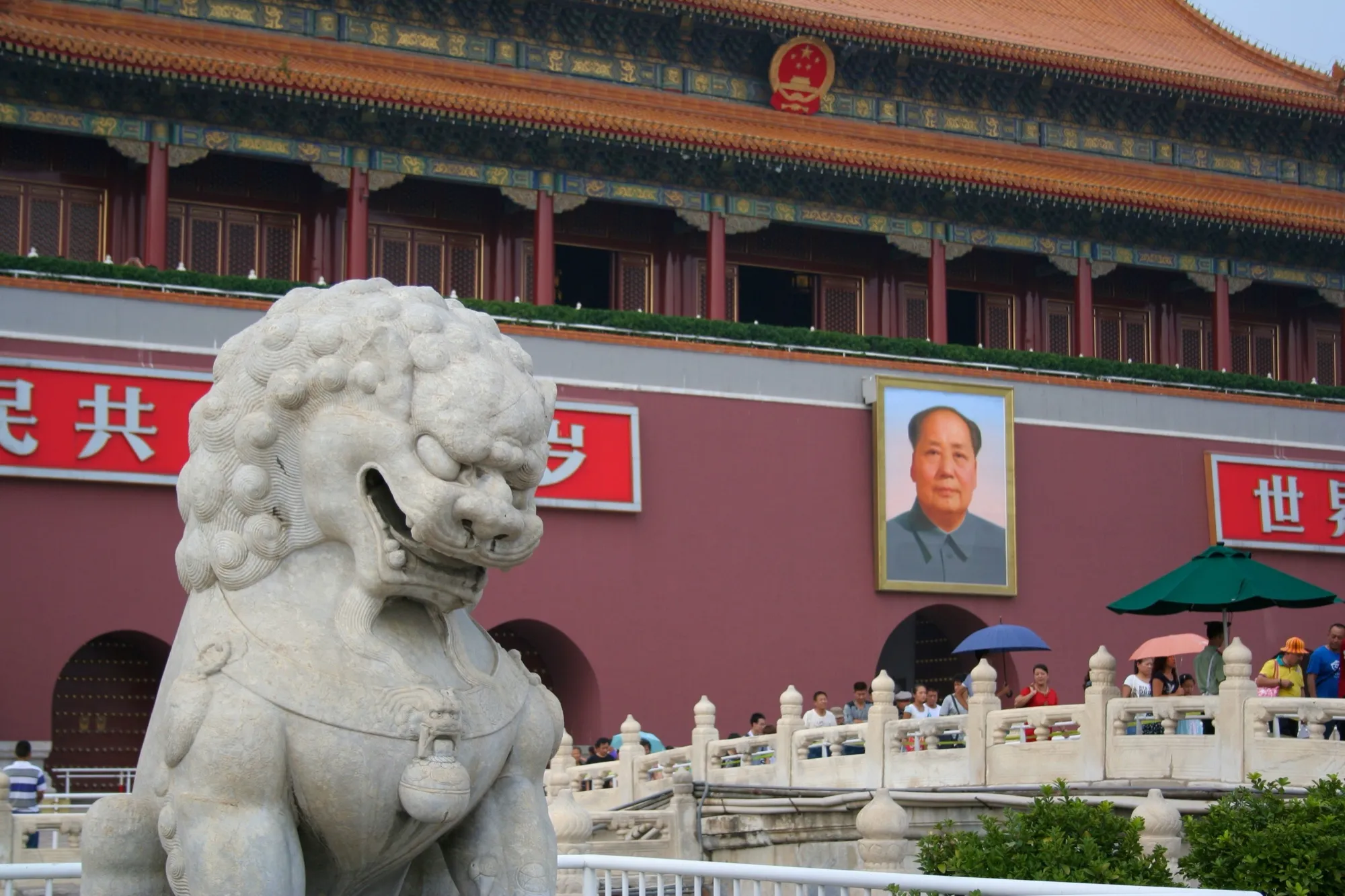
Mao’s portrait on the Tiananmen Gate, 2011. Photo: Michael Day, CC BY 2.0, via Wikimedia Commons.

As a Maoist, I have never repudiated the Cultural Revolution, and I would never call Mao Zedong a dictator. Rather than say he was a dictator, I would say the system of the Chinese Communist Party is itself a dictatorship; it is not one man’s problem. Mao has been dead for fifty years now. The system has passed through generation after generation of leaders, and it is still here; putting everything on one man only lets the system off the hook.
The irony is that a view like mine cannot be spoken in either chamber. Outside China, speaking up for Mao is easily taken as defending a dictator; inside China, refusing to repudiate the Cultural Revolution goes against the verdict the Party passed on it in its 1981 resolution on its own history. This is what I meant by “cannot be judged”: you may not curse the totem, and you may not love it in any way but the official one.
III. The Freedom to Offend, and Its Price
Mao is not the only thing that cannot be touched. As I’ve said before, people will happily joke about 9/11, insult France and mock Napoleon, but they will never turn the joke on themselves, because everyone lives inside a cage: the Chinese internet is a high-voltage fence, and the internet outside China is a Faraday cage that conducts. Touch the live wire and an unknowable iron fist comes down, and once again everyone can only talk in riddles.

So we are back to euphoria. At heart, this was yet another meaningless carnival across the whole internet: people did not care in the least who this public figure was; one sentence that simply must not be said, and everyone turned against him. Gustave Le Bon’s The Crowd describes exactly this. From political euphoria to the euphoria of online abuse to euphoria in real life, no person and no event has reasons any more, only sides.
So politics as entertainment is itself a joke. When everyone is inside their own chamber, the people you offend are always someone else; political systems differ, so the punishments are only bigger or smaller. China under the Chinese Communist Party is a dictatorship, so it naturally handles things the way a dictatorship does. Euphoria gives everyone the freedom to enjoy themselves and to speak, but it cuts both ways, and offence always has consequences. Public figures are different: they can offend more people, and the consequences are more serious.
So should politics be turned into entertainment at all? There is no settled answer. Historical figures in themselves carry no judgement; they are facts that existed. Politics is different. Historical figures are also political figures, closely bound up with present-day politics and real life. Mocking Israel and playing with Nazi jokes, or insulting Mao Zedong: none of it is a problem in itself; that is your freedom of speech. But people live in the real world, the real world always has politics, and politics cares about some history, because its very existence is bound up with history.
That is our world. The internet has strengthened the world’s connections and weakened everyone’s sensitivity. A great deal of history is the very foundation politics stands on; politics and history were never separate. Once nothing is left but euphoria, you bear the consequences yourself. That is what is absurd: everyone finds comfort in offending and being offended.
IV. Living in the Present
And when I look at real life, it is more absurd still. This month France went through its worst unrest in years: the cost of living, fuel prices, public services and the state of the schools drove students, trade unions and the gilets jaunes into the streets, and the fires spread from Paris to Marseille and Lyon. And I, living in London, had my phone snatched yesterday. I didn’t fight back; as an ordinary person, there was nothing I could do. Google released its earnings, and the shares plunged again. The bigger social questions, artificial intelligence replacing jobs, unemployment, a tech bubble, are touching every ordinary person in real ways. Real life is, in fact, getting worse and worse.
Faced with this, if you choose to escape, you inevitably sink into life online, enjoying the euphoria and losing more and more of your ability to think. The rise and spread of politics as entertainment, and the growing extremity of online abuse, are closely tied to the real world we live in.
And me? It has been a long time since the year I wrote Extreme Euphoria, eight or nine years. Back then I wrote: how do you dissolve extreme euphoria? Only by treating one another with a true heart, and keeping a heart that seeks the genuine. At the time I thought the emptiness would go away only if everyone treated one another with a true heart, so in the end I could only admit it was a utopia. I’m no longer a child, either. I live inside this society, and I don’t expect myself to achieve anything or change anything. I tell everyone around me: let’s not talk about social issues or politics, because every word will offend somebody. But as someone who thinks, when my partner and I have a deep talk, I always say what I really think, and I enjoy the process of thinking. My answer has become much smaller: tell the truth to the one person beside me. That is probably what “treating one another with a true heart” can look like today, and it is my small trick for resisting extreme euphoria.
Enjoy thinking, and the conversations thinking brings; don’t be afraid of it, and don’t grow tired of it. Even I enjoy euphoria while I think: I enjoy slacking off, I enjoy life. Back then I said extreme euphoria cannot be solved, only dissolved, until it and you become one; thinking and euphoria can exist side by side. That is how to live. We don’t live in a film. We live in the present.